

Life Jacket–Integrated POB Tracking System
In the vast unpredictability of the open ocean, time is the only currency that matters. When a Person Overboard (POB) situation occurs, the window for a successful rescue closes with every passing minute. The Life Jacket–Integrated POB Tracking System represents a paradigm shift in maritime safety, transforming a traditionally passive wearable into a proactive, intelligent safety hub designed to ensure that being lost at sea no longer means being out of reach.
Traditional life jackets are passive tools that rely entirely on the hope that a rescuer’s eyes will spot a small silhouette against a restless, gray horizon. Existing solutions are often limited by:
- Manual Dependency: Requiring a conscious or mobile survivor to activate signals.
- Visibility Issues: Poor performance in heavy fog, darkness, or high-sea states.
- Search Inefficiency: Rescuers often lack precise, real-time coordinates, leading to “needle in a haystack” search patterns.
Overview
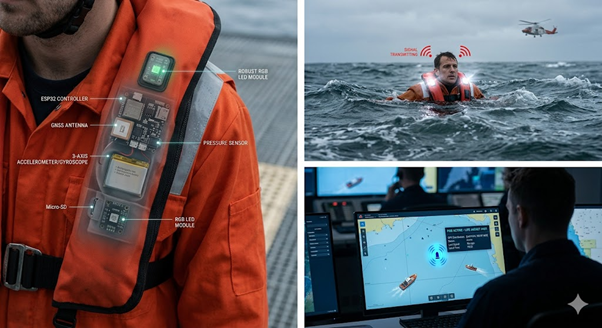
The system bridges the gap between flotation and location through a high-performance ESP32-based controller integrated directly into the life jacket. By merging GNSS geolocation with kinetic and environmental data, the device functions as a wearable mission control. It autonomously understands its exact position, orientation, and the specific context of distress, transmitting critical data through a multi-path communication strategy to ensure help is summoned immediately.
Key Features
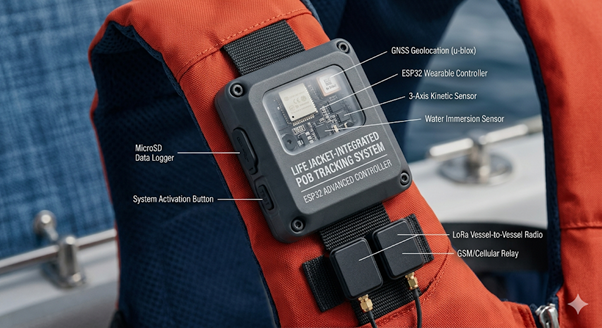
- Intelligent Detection Logic: Uses a 3-axis accelerometer, gyroscope, and pressure sensors to distinguish genuine emergencies from routine activity based on impact and immersion patterns.
- Multi-Path Communication: Employs LoRa for long-range, low-power vessel-to-vessel signals and GSM/cellular networks for coastal relay.
- Hybrid Activation: Supports both autonomous triggers (via sensor data) and manual user activation to ensure credibility and urgency.
- Layered Local Alerts: High-intensity RGB LEDs and audible buzzers provide immediate visual and acoustic guidance for nearby rescuers.
- Incident Data Logging: An onboard MicroSD card acts as a “black box,” recording movement history and environmental conditions for post-incident analysis.
Artificial Intelligence refers to the development of computer systems that can perform tasks that would typically require human intelligence. It involves the creation of algorithms and models that enable machines to learn, reason, perceive.
Adam Peterson
Applications
The versatility of this integrated architecture allows for deployment across various high-risk maritime sectors:
- Commercial Shipping: Protecting crew members on large cargo vessels.
- Offshore Energy: Safety monitoring for workers on oil rigs and wind farms.
- Passenger Transit: Enhancing emergency protocols for ferries and cruise lines.
- Recreational Boating: Providing a professional-grade safety net for private sailors and fishers.
Benefits
- Reduced Response Time: Drastically narrows the “detection-to-extraction” gap by providing real-time GPS coordinates.
- Elimination of False Alarms: Sophisticated sensor fusion ensures alerts are only triggered under specific, credible distress conditions.
- Enhanced Survivability: Active local signaling (lights/sound) assists rescuers in the “final mile” of recovery, even in low-visibility environments.
- Data-Driven Safety: Provides invaluable insights for reconstructing maritime incidents and improving future safety protocols.
Deployment & Scalability
Designed with a modular approach, the system can be integrated into existing life jacket designs or manufactured as a standalone safety module. Its low-power consumption and flexible communication architecture allow it to scale from small-scale local fleets to global commercial operations. The use of LoRa technology ensures the system remains functional even in “dead zones” far from traditional cellular coverage.
Future Scope
- Satellite Integration: Expanding communication range to the most remote corners of the globe via LEO satellite networks.
- Biometric Monitoring: Integrating heart rate and body temperature sensors to provide rescuers with the survivor’s medical status in real-time.
- AI-Enhanced Predictive Drift: Using historical current data to predict a survivor’s movement if signal is temporarily lost.
The Life Jacket–Integrated POB Tracking System is more than a safety device; it is a comprehensive survival architecture. By replacing hope with data and passive flotation with active communication, it significantly increases the probability of survival in the world’s most challenging environments. In an industry where every second counts, this technology ensures that help is not just coming, but is already on the way.