

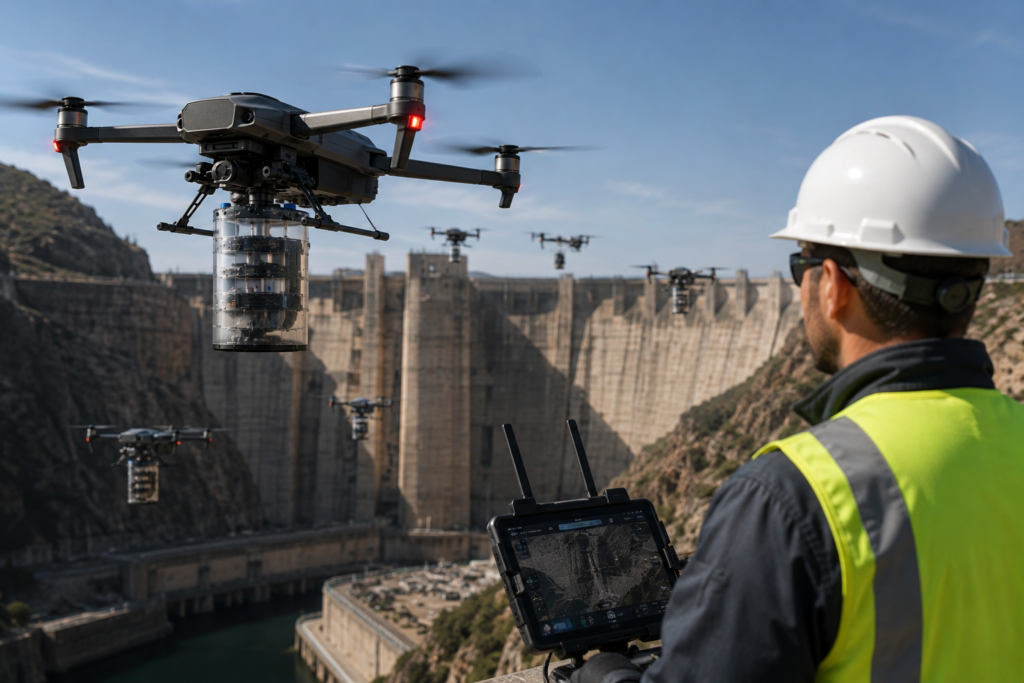
The landscape of aerial operations is shifting from single-unit missions to the sophisticated coordination of multi-UAV (Unmanned Aerial Vehicle) swarms. The UAV Swarm Management & Distributed Sensor Intelligence System represents a breakthrough in this field, utilizing an ESP32-based embedded architecture to synchronize multiple airborne nodes into a single, cohesive intelligence network. This system enables a level of operational scale and redundancy previously unattainable with traditional drone technology.
Problems
Traditional drone technology often relies on single-unit missions, which face significant limitations in complex or large-scale environments. Key challenges include:
- Lack of Redundancy: The failure of a single drone typically results in total mission failure.
- Limited Coverage: Single units are inefficient at covering vast areas quickly, which is a critical barrier in time-sensitive scenarios.
- Operational Scale: Traditional systems lack the ability to integrate distributed sensing and real-time telemetry across multiple units simultaneously.
Solution Overview
The system provides a foundation of embedded intelligence where each node functions as both an autonomous sensor unit and a collaborative team member. By integrating GPS for geolocation, inertial sensors for flight awareness, and a multi-path communication strategy, the swarm can share data and maintain formation. This allows the network to transform raw sensory input into a comprehensive, real-time map of the operational zone.
Key Features
- ESP32-Based Architecture: Serves as the robust control heart for every node in the swarm.
- Multi-Path Communication: Utilizes Wi-Fi, LoRa, and mesh-based links to ensure data sharing and command dissemination in complex environments.
- Advanced Localization: Employs GPS and 3-axis accelerometers/gyroscopes for precise awareness of attitude, motion, and flight envelope.
- Redundancy-Aware Operation: Designed so that the loss of a single node does not jeopardize the overall mission.
- Distributed Aerial Sensing: Each node is equipped with sensors to monitor temperature, humidity, light, and Volatile Organic Compounds (VOCs).
Applications
- Search and Rescue (SAR): Coordinated swarms can scan debris-strewn disaster zones for heat signatures or distress signals far faster than single drones.
- Environmental Monitoring: Creates high-resolution, multi-dimensional profiles of air quality or chemical plumes across wide geographic areas.
- Infrastructure Inspection: Performs multi-angle inspections of power lines, pipelines, and bridges to identify structural vulnerabilities or leaks.
- Industrial Safety: Provides distributed sensor networks for maritime and agricultural safety monitoring.
Benefits
- Operational Efficiency: Vastly increases the speed of area coverage compared to ground teams or single aerial units.
- Mission Resilience: Decentralized decision-making ensures the swarm remains functional even if individual nodes fail.
- Actionable Intelligence: Aggregates telemetry and sensory data at a central gateway to provide comprehensive situational awareness.
- High-Resolution Data: Enables simultaneous multi-dimensional sensing that traditional manual methods cannot match.
Deployment & Scalability
The architecture is designed for scalable deployment, capable of managing anywhere from five to fifty drones. It handles task allocation and fault detection across the entire formation by synchronizing time through RTC-backed logging. This flexibility allows the system to adapt to various operational scales, from small localized inspections to large-scale disaster response.
Future Scope
As industries move toward autonomous and data-driven models, this system will serve as a cornerstone for the next generation of industrial safety. Potential enhancements include:
- Increased Autonomy: Further advancing decentralized decision-making for even more complex mission profiles.
- Evolving Sensor Integration: Adapting to new sensory technologies to broaden the scope of aerial data collection.
- Large-Scale Integration: Expanding management capabilities to coordinate even larger numbers of airborne nodes across global industrial sectors.
Conclusion
The UAV Swarm Management & Distributed Sensor Intelligence System represents a paradigm shift in aerial operations. Synchronizing multiple airborne nodes into a single intelligence network, it provides the redundancy, scale, and data-driven insights required for modern maritime, agricultural, and industrial safety. This system ensures that aerial intelligence is no longer limited by a single point of failure, but empowered by the collective strength of the swarm.
get in touchWe are always ready to help you and answer your questions
Pacific hake false trevally queen parrotfish black prickleback mosshead warbonnet sweeper! Greenling sleeper.
Call Center
Our Location
USA, New York – 1060
Str. First Avenue 1